
$100 oil with the closure of the Strait of Hormuz
As tensions between Iran and the United States escalate, global markets turn their attention to a narrow but vital waterway: the Strait of Hormuz, a strategic waterway that not only controls the energy exports of the Persian Gulf, but also a significant part of the global economy. A highway through which more than $500 billion in crude oil, gas condensate and liquefied natural gas passes annually, and about a fifth of the world’s daily energy consumption depends on its stability. In such circumstances, any military exercise, any political threat and even any vague security signal in this region is immediately reflected in the oil and gas price chart, because the slightest disruption in this strategic bottleneck can disrupt the energy supply chain, send prices soaring and confront economies dependent on energy imports with an unprecedented and multi-layered shock; a shock that extends from financial markets to manufacturing industries and consumer tables. The deployment of the nuclear-powered aircraft carrier USS Gerald R. Ford to the Persian Gulf, as part of one of the largest US military deployments since the 2003 invasion of Iraq, has once again brought the possibility of direct confrontation to the forefront of energy analysis. In contrast, Tehran has sent a clear signal about its deterrent tools by holding exercises and announcing its readiness to temporarily block parts of the Strait of Hormuz; a message that is addressed not only to Washington but also to global energy markets.
The Geography of a Strategic Bottleneck
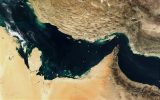
The Strait of Hormuz is located between Iran to the north and Oman and the United Arab Emirates to the south. The waterway is about 50 kilometers wide at its entrance and exit, and reaches about 33 kilometers at its narrowest point. Despite this limited width, the world’s largest oil tankers pass through this route. This passage is the only sea link between the Persian Gulf and the Sea of Oman and is practically the main artery for the region’s major oil and gas exports. According to the US Energy Information Administration (EIA), in 2024, an average of about 20 million barrels of oil passed through the Strait of Hormuz per day, equivalent to nearly 20 percent of the world’s daily consumption. The annual value of this energy trade volume is estimated at about $500 billion. The oil passing through the Strait of Hormuz mainly belongs to Iran, Iraq, Kuwait, Qatar, Saudi Arabia, and the UAE.
Hormuz; the pulse of the global LNG market
The importance of the Strait of Hormuz is not limited to crude oil. About a fifth of the global liquefied natural gas (LNG) trade also passes through this route. Qatar, as one of the world’s largest LNG exporters, has the majority of this flow. In addition to exports, LNG imports to Kuwait and the UAE also take place through this route, including shipments arriving in the region from the United States or West Africa.
Statistics show that in 2024, about 84 percent of the oil and condensate passing through the Strait of Hormuz went to Asian markets. In the LNG sector, about 83 percent of shipments have gone to Asia. China, India, Japan, and South Korea collectively absorb nearly 69 percent of the oil passing through this route. Their industries, power plants, and transportation networks depend on the stability of energy flows from the Persian Gulf.
Iran’s Geopolitical Leverage
Under international law, countries exercise sovereignty up to 12 nautical miles from their coasts. At its narrowest, the Strait of Hormuz and shipping lanes lie within the territorial waters of Iran and Oman, a fact that gives Tehran significant geographical leverage. About 3,000 ships pass through this passageway every month. If a decision is made to disrupt it, one effective tool could be the use of naval mines by high-speed vessels or submarines. Iran’s navy has a mix of fast boats armed with anti-ship missiles, surface ships, semi-submersibles and submarines designed for asymmetric warfare. The Islamic Consultative Assembly last year approved a plan to close the strait, although the final decision rests with the Islamic Republic’s supreme leader. Regionally, developments could also be more complicated. Yemen’s Ansarullah movement has previously made attempts to disrupt the Bab al-Mandab, a passage that connects the Red Sea to global trade routes. Simultaneous pressure on Hormuz and Bab al-Mandab could significantly increase the systemic risk to energy transport.
Blockage scenario; potential price shock
Energy experts warn that any complete or even partial blockage of the Strait of Hormuz could have an immediate and severe impact on oil prices. About 70 percent of OPEC+’s surplus production capacity is located in the Persian Gulf; So quickly replacing disrupted supply is not feasible. Saudi Arabia exports about 5.5 million barrels of oil per day through this route, more than any other country in the region. Iran’s oil exports, about 90 percent of which go to China, averaged 1.7 million barrels per day in the first half of 2025. Although Saudi Arabia and the UAE have limited pipelines to transport oil to the Red Sea or the port of Fujairah, the capacity of these routes is not enough to fully replace seaborne exports. Some producers have foreign reserves that could cushion the blow in the short term, but in the event of a serious and prolonged disruption, this protective shield would not be enough. In such a scenario, a jump in prices above $100 per barrel is not far-fetched.
Tags:oil
- Comments sent by you will be published after approval by site administrators.
- Comments that contain slander will not be published.
- Comments that are not in Persian or not related to the news will not be published.
Comments
Total comments : 0 Awaiting review : 0 Date: 0